
We Believe, Teach & Confess
With the one, holy, Christian and apostolic church, The Lutheran Church—Missouri Synod (LCMS) confesses the three ecumenical creeds: The Apostles' Creed, the Nicene Creed and the Athanasian Creed. These creeds state that the three persons of the Holy Trinity are coequal and coeternal, one God.
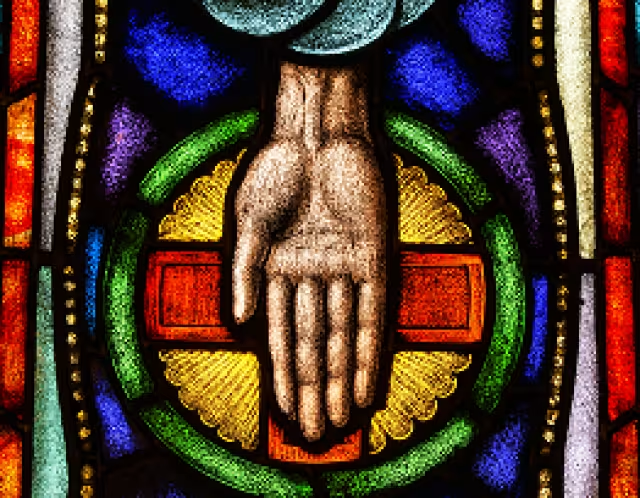
The Father
God the Father created the world and all that exists and still sustains His creation by His Word of power.
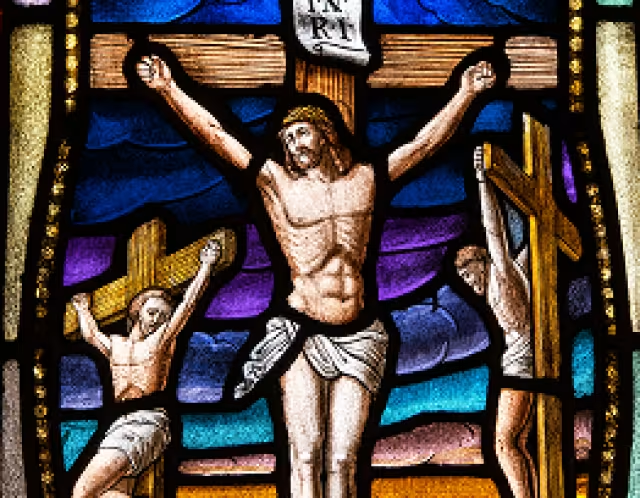
The Son
Jesus Christ, the Son of God, became man to suffer and die for the sins of all humanity and to rise to life again in victory over sin, death and the power of the devil.
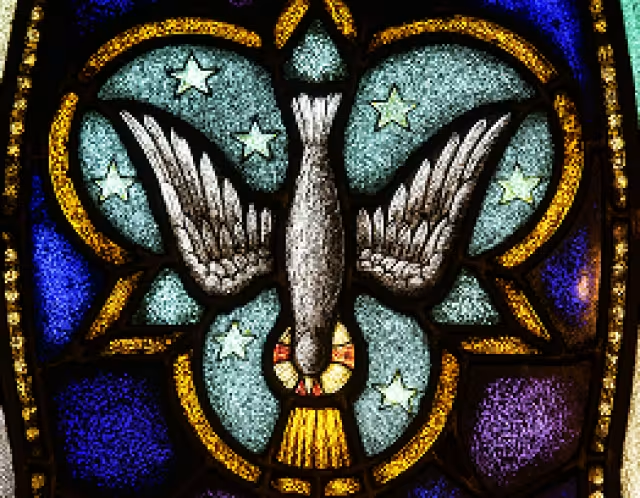
The Holy Spirit
The Holy Spirit creates faith through the proclamation of the Word of God and the administration of the Sacraments.
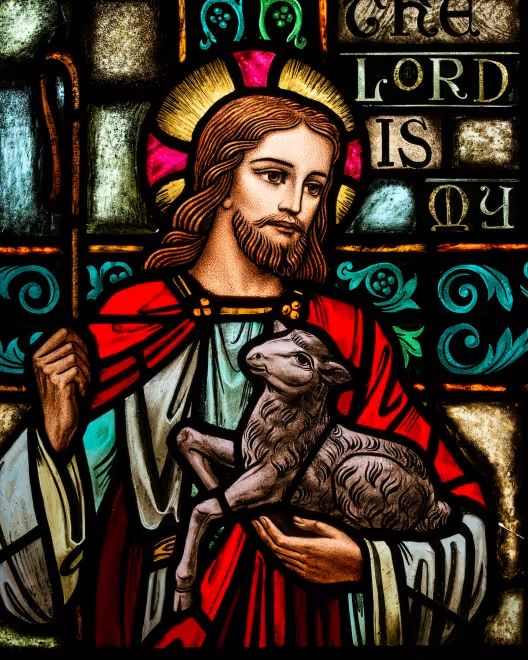
Who is Jesus?
In a world in which information is readily available and opinions abound, this fundamental question stands above all other inquiries and considerations.
The LCMS believes Jesus is exactly who He said He is. Along with the ancient church, we confess that Jesus is true God and true man in one person. He is the Son of God who was crucified and raised from the dead for the salvation of all who trust in Him.
Christ is not Jesus’s last name but identifies Him as the Messiah (Christ is the Greek translation of Messiah), the fulfillment of the Old Testament promises that God saves His people.
This fulfillment and salvation happened in history in real time and in a real place (first century AD in Israel) through a flesh-and-blood person named Jesus.
The Bible is the true and trustworthy Word of God that records God’s love for the world through His Son, Jesus. The miracles recorded in the Gospels and the teachings of Jesus are true and accurate.
Jesus physically died on a cross and physically rose from the dead in three days. He physically ascended into heaven, and the church awaits His second coming when He will judge all people.
Those who trust in Jesus as their Savior will rise to eternal life in heaven. Those who deny Jesus and live in their sin will be cast out of His presence to hell.
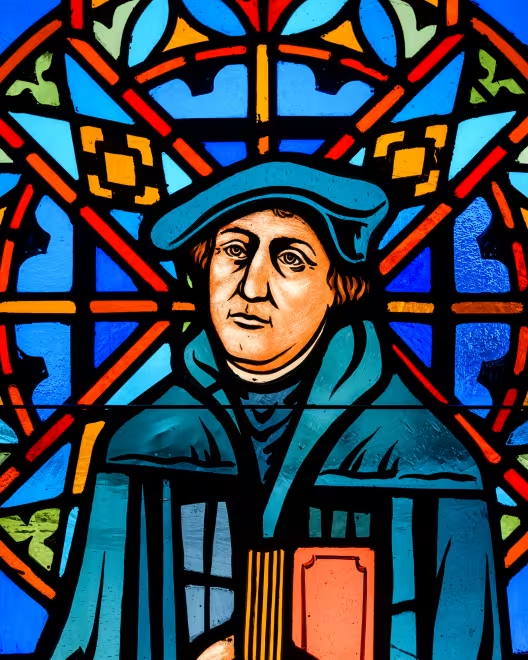
What is a ‘Lutheran’?
In the 16th century, God sent a German friar to call the medieval church back to the central teaching of Scripture. That friar was Martin Luther. While he challenged the unbiblical accretions of the medieval Roman Catholic Church, he also pointed the Christians back to the centrality of Jesus' atoning work for the sins of the world.
The biblical teachings of Martin Luther and his fellow reformers were, after his death, collected in the Lutheran Confessions. Our LCMS congregations believe the Lutheran Confessions are a correct interpretation and presentation of biblical doctrine, as they are contained in the 1580 Book of Concord: The Confessions of the Evangelical Lutheran Church. Luther’s Small Catechism contains essential summaries of our beliefs, while the Augsburg Confession gives more detail about what Lutherans believe.
What does “Synod” mean? That word in The Lutheran Church—Missouri Synod comes from Greek words that mean “walking together.” The term has rich meaning in our church body because congregations voluntarily choose to belong to the Synod. Though diverse in their service, our congregations hold to a shared confession of Jesus Christ as taught in Holy Scripture and the Lutheran Confessions.
Doctrinal Statements
The LCMS has also adopted three historical yet timeless doctrinal statements that further clarify its theological position and teachings:
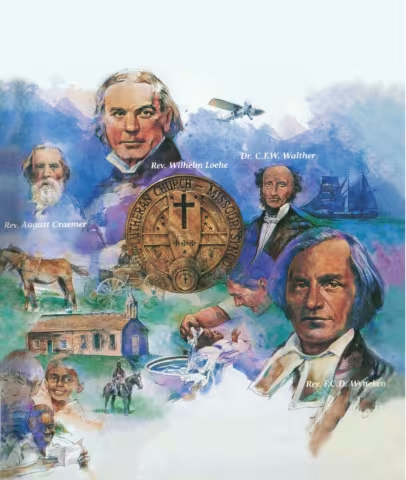
An Introduction to The Lutheran Church—Missouri Synod
This booklet presents (1) a brief overview of the history, mission and ministry of the LCMS; (2) a discussion of the foundational Lutheran beliefs as held and taught by the Missouri Synod; and (3) the Missouri Synod's understanding of the nature and mission of the church and its relationship with other Christian denominations.
Frequently Asked Questions
Because of the fall (Gen. 3; Rom. 5), all mankind fell from perfect obedience to and relationship with God. This is how sin — and, with it, death — entered the world. Salvation is God’s act of setting Christians free from bondage to sin, death and the devil; declaring them righteous on account of the work of Christ; and giving them eternal life with Him. To reject salvation is to reject God Himself, which is to choose hell, from which God and His love are absent.
The forgiveness of sins is not something we can earn; rather, it was earned for us by Jesus Christ, true God and true man, by His crucifixion and death undertaken on behalf of us and our sin. Jesus rose again on Easter and later ascended into heaven, where He reigns and from which He will return on the Last Day to judge the living and the dead. In the meantime, this forgiveness of Christ’s is a free gift to all who desire it. This forgiveness is especially given through the Sacraments, which are the Means of Grace, established by Jesus.
Baptism is a Sacrament, a physical means established by Christ to give salvation. In Baptism, the Word of God joined with the water drowns the old Adam, washing the Christian clean and naming him or her as a forgiven child of God. This is not by any action or merit on the part of the Christian, which is why Baptism is conferred on babies, children and adults alike in the Lutheran church.
The Lord’s Supper (also called Communion or the Eucharist) is a Sacrament, a physical means established by Christ to forgive sins, and along with that comes life and salvation, to those who partake of the Supper with faith in Christ and His Word of promise. In the Lord’s Supper, Christ dwells in body and spirit in, with and under the bread and wine, granting forgiveness of sins and life everlasting to those who partake worthily.
The LCMS believes that the Bible is unlike any other book, namely, it is the inspired and inerrant Word of God. The human authors who wrote the books contained in the Bible were writing under divine inspiration, and it was God’s Word, not their fallible words, that they wrote. This is how the apostles and Christ Himself viewed the Bible, as is clear in the Gospels and Epistles of the New Testament.
Members in good standing of the LCMS and her sister church bodies may commune at LCMS congregations. This practice, known variably as close, closed or close(d) Communion, stands in contrast to open Communion, whereby anyone who desires may commune regardless of profession of faith or member status. By rejecting the practice of open Communion, pastors and communing laity alike preserve a unity of confession regarding the Sacrament, namely, that in, with and under the elements Christ is present as He promised for the forgiveness of sins. Pastors may, nevertheless, exercise discretion in special cases or emergencies.
In addition to the LCMS, the Evangelical Lutheran Church in America (ELCA) and the Wisconsin Evangelical Lutheran Synod (WELS) are the other two largest American Lutheran church bodies.
The LCMS differs from the WELS with regard to biblical fellowship (i.e., the nature of joint prayer), doctrine of the ministry (i.e., the nature of the pastoral office), and the role of women in the church (i.e., women’s suffrage in church voting assemblies). The LCMS and WELS remain in fraternal dialogue.
The LCMS differs from the ELCA with regard to biblical fellowship (i.e., the level of doctrinal agreement necessary for church fellowship or membership), the doctrine and authority of Scripture (i.e., the infallibility of the Bible, especially with regard to topics like homosexuality, abortion and a male-only pastoral office), and the type of commitment or subscription required from pastors to the Lutheran confessional documents (i.e., the degree to which they remain binding as opposed to merely historical). In all three above cases and in others, the LCMS rejects the ELCA’s tendency to disregard Scripture and/or the Confessions on those topics outside of the narrow understanding of the Gospel, a practice called “gospel reductionism” that led to the 1974 Concordia Seminary Walkout and subsequent schism in the LCMS that eventually contributed to the establishment of the ELCA.
https://reporter.lcms.org/2025/paper-outlines-state-of-lcms-wels-els-talks/
https://witness.lcms.org/2022/a-lutheran-perspective-on-the-elca/
Disunity in the church has been a sad reality throughout church history. Today, there are literally thousands of denominations, not to mention thousands of non-denominational congregations, all of which differ from one another. To put it simply, Lutherans occupy a sort of “middle way”: Unlike the Roman Catholic and Orthodox churches, the LCMS holds to Scripture alone as the final doctrinal authority for the Christian; unlike most Protestant traditions (e.g., Presbyterians/reformed, Baptists), the LCMS confesses the Sacraments as the means through which God acts to forgive us from sin, rather than mere opportunities publicly to confess our faith. Additional differences abound, far too many for enumeration here. To help readers navigate the differences between the LCMS and other denominations, The Lutheran Witness has produced two issues, one on 12 well-known church bodies and the ways they differ from the LCMS, and another on common theological terms and how their definition and use differs between the LCMS and other church bodies.
https://witness.lcms.org/2025/lutheran-witness-october-2025/
https://witness.lcms.org/2022/lutheran-witness-october-2022/
https://witness.lcms.org/2024/lutheranism-and-other-denominations-booklet/
Talk to your pastor. After visiting an LCMS congregation, meet with the pastor there to learn how he conducts new member instruction. Regardless of the method at your local congregation, you can expect to go over the central tenets of the Lutheran faith, which are expressed in Martin Luther’s Small Catechism. If you have not yet visited an LCMS congregation, you can find one today with the LCMS Locator.
An excellent and accessible resource explaining the doctrine of The Lutheran Church—Missouri Synod is the “What About?” pamphlet series, a collection of 27 pamphlets written by the Rev. Dr. A.L. Barry, former president of the LCMS. Additionally, you may find three historical yet timeless doctrinal statements formally adopted by The Lutheran Church—Missouri Synod: the Rev. Dr. C.F.W. Walther’s Theses on the Ministry (1851), Brief Statement of the Doctrinal Position of the Missouri Synod (1932), and A Statement of Scriptural and Confessional Principles (1973).
The LCMS Commission on Theology and Church Relations (CTCR) provides study documents, opinions and statements on a variety of topics, including many contemporary issues like end-of-life decision-making, abortion, social media and other digital technology, gender dysphoria, gambling, racism, and more. For additional resources, The Lutheran Witness, an official periodical of The Lutheran Church—Missouri Synod, helps readers interpret the contemporary world from a Lutheran Christian perspective.
LCMS Worship produces a variety of resources for use in the congregation or the home. With monthly and seasonal planning materials, liturgy audio recordings, educational bulletin inserts, and a variety of home devotional and study materials, there are resources available for clergy, church musicians, congregants and children alike.
Additional Resources
Christian Cyclopedia
This digital encyclopedia provides information about the names and terms of significant people, places, ideas and institutions in church and secular history.
ViewCommission on Theology and Church Relations
The CTCR provides study documents, opinions and statements on current theological issues.
View