Filter & Sort
Search
December 5, 2017
"Savior of the Nations, Come" – Hymn Feature
“Savior of the Nations, Come” includes longing or expectation for a Savior; the work of Jesus and His triumph over death; and life in the light of Christ. It is the appointed Hymn of the Day for the first Sunday in Advent in both the one and three-year lectionary.
November 29, 2017
"Wake, Awake, for Night is Flying" – Hymn Feature
This Parable of the Ten Virgins basis for Philipp Nicolai’s great hymn, “Wake, Awake, for Night Is Flying” (LSB 516). Known as the “King of Chorales,” this is the Hymn of the Day for the Last Sunday of the Church Year.
October 31, 2017
“A Mighty Fortress Is Our God” – Hymn Feature
The precise motivation for Luther’s text is unclear, yet evidence exists that it spread quickly and gained notoriety in significant fashion. It was sung at the Diet of Augsburg (1555) and in all the churches of Saxony.
June 4, 2017
“Come, Holy Ghost, God and Lord” – Hymn Feature
Theologically, this chorale is based on the work of the third Person of the Holy Trinity, the Holy Spirit (Ghost), who is expressly celebrated on the Day of Pentecost.
April 24, 2017
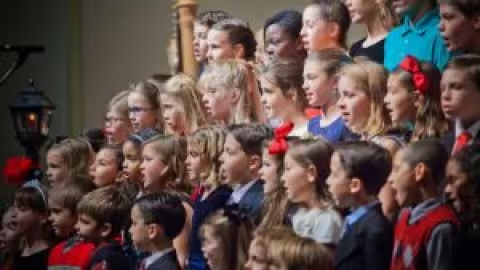
How To Teach Children a Reformation Hymn
The Reformation was birthed by adults, but it is preserved by children. For centuries, pastors and parents have been preaching a holy heritage into the ears of the young, clearly confessing a salvation by grace alone through faith alone in Christ alone.
January 9, 2017
“O Morning Star, How Fair and Bright” – Hymn Feature
Based on Psalm 45, the hymn quickly became extremely popular in Germany and was used for a variety of occasions. The tune is believed to be a reconstruction of “Jauchzet dem Herren, alle lande,” Psalm 100, included in Wolff Köphel’s Psalter (1538).
December 24, 2016
The Gloria in Excelsis
“Glory to God in the Highest” is the first Christmas carol. It was sung by the angels to the shepherds on the night when Jesus was born (Luke 2:14). But Christmas is not the only time that we sing “Glory to God in the Highest.”
November 21, 2016
“The Bridegroom Soon Will Call Us” – Hymn Feature
The uplifting expression of faith and joy at Christ’s second coming in “The Bridegroom Soon Will Call Us” (LSB 514) by Johann Walter and Michael Praetorius reminds us that there is meaningful history in so many of our great Lutheran hymns.
October 22, 2016
“Lord, Keep Us Steadfast in Your Word” – Hymn Feature
Luther’s Reformation hymn, “Lord, Keep Us Steadfast in Your Word” (LSB 655) is one of his best known compositions. When it was published in 1542, it appeared with the subtitle, “A Children’s Hymn, to be Sung Against the Two Archenemies of Christ and His Holy Church, the Pope and Turk.”[1]
September 19, 2016
“Dear Christians, One and All, Rejoice” – Hymn Feature
In 1523 Martin Luther wrote his first hymn for congregational use, “Dear Christians, One and All, Rejoice” (LSB 556). It appears as the first hymn in the first published collection of Lutheran hymns, Etlich Cristlich lider of 1523/24.
July 18, 2016
Hymns Are Devotions
Our hymnal is a treasury of devotions. Although we mainly think of hymns in the context of corporate worship, they are also perfectly suited for devotional use in the home.
June 30, 2016
“We All Believe in One True God” – Hymn Feature
As the basis for “We All Believe in One True God,” Martin Luther used the first two lines of a single-stanza German medieval hymn first found with Latin and German words in 1417 and expanded it to three stanzas—individually paraphrasing each of the three articles of the creed.
March 15, 2016
“From Depths of Woe I Cry to Thee” – Hymn Feature
One of Luther’s earliest compositions was “From Depths of Woe I Cry to Thee,” a paraphrase of Psalm 130 (Aus tiefer Not schrei’ ich zu dir, LSB 607). He wrote this hymn in 1523, around the time that he was revising the Latin Mass.
December 28, 2015
“From Heaven Above to Earth I Come” – Hymn Feature
While it may be difficult to finalize and stop selecting hymns for your season, perhaps a place to start is with Martin Luther’s Christmas gem, “From Heaven Above to Earth I Come” (LSB 358).
December 22, 2017
Luther's Hauspostille
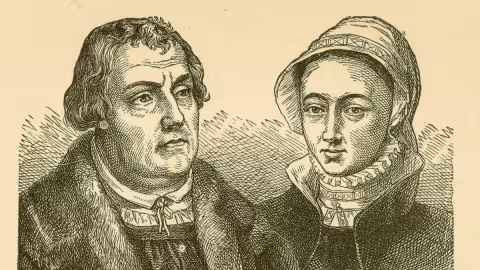
Picture yourself sitting in Luther’s house. It’s Sunday, late in the day and many others are gathered with you in the old Augustinian monastery-turned-parsonage in Wittenberg. Around you sits...
November 11, 2017
Luther's Baptismal Rites
Martin Luther actually produced two different orders of baptism. The first Order of Baptism was published in 1523. It was basically a translation of the existing Latin rite into German, with a few minor changes, mainly the addition of the Flood Prayer. This order was revised in 1526, primarily by simplifying and shortening it.