The Schiebel Grant Program is offered through The Lutheran Church—Missouri Synod’s Office of National Mission. This grant opportunity supports LCMS congregations, schools, Recognized Service Organizations (RSO), Concordia University System schools and LCMS seminaries by funding small, short-term projects that give physical, medical and spiritual support to black inner-urban residents.
The Schiebel Grant Program is funded by the Rev. Dr. William A. Schiebel Endowment fund, which is under the custodianship of the LCMS Foundation. This fund was established to give thanks for the dedicated service of this faithful Lutheran pastor and churchman. Through 50 years of parish ministry, Dr. Schiebel worked tirelessly to share the Good News of Christ Jesus with the black inner-urban community of Washington, D.C. Many times during his ministry, he had an idea or found a ministry opportunity to meet the needs of the community and open doors to share the Gospel only to have the opportunity thwarted by a lack of funding. The endowment in his name seeks to remedy this problem.
Schiebel Project grants
- Plan a project to reach and support black inner-urban residents
- Apply online anytime
- Awards between $1,000 and $2,000
Contact us
For questions about grants, contact grants@lcms.org or 888-THE LCMS.
Pastor Schiebel’s Biography
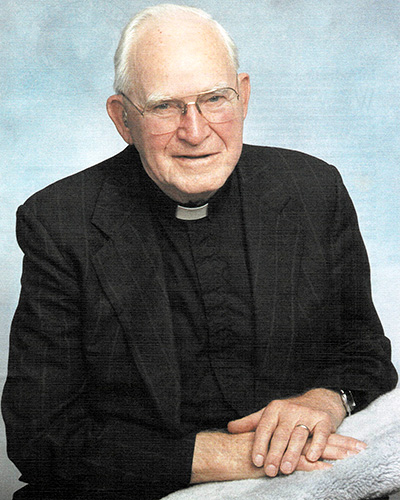 The Rev. Dr. William A. Schiebel, a faithful and selfless pastor and churchman, dedicated his life to serving black and inner-city congregations, so that all people may come to hear the Gospel and be one in Christ’s church.
Schiebel was born on March 8, 1905, in Nicolet, Minn., to August and Augusta Schiebel. He was the fifth of seven children. His father, an immigrant from Saxony, Germany, was a stonemason; Schiebel grew up helping on the family farm and assisting his father with his masonry jobs.
Schiebel decided to enter the pastoral ministry when he was 21. In September 1927, he enrolled at Concordia Theological Seminary, Springfield, Ill. A long list of odd jobs helped put him through seminary: a carpentry job to remodel a dormitory, chauffeuring a Seminary professor who traveled around to preach at many rural parishes, working in a pea and corn canning factory, and working as a church janitor.
The seeds for Schiebel’s lifelong work to share the love of Christ with all people of every race and background were planted while he was at seminary. In 1927, he began attending Holy Trinity Lutheran Church in Springfield simply because it was the church closest to campus; as it turned out, Holy Trinity was an all-black congregation. Parishioners gave him a warm welcome, and the pastor, the Rev. Dr. Andrew Schulze, would be a great influence on Schiebel on the subject of race relations in the United States and in the Synod.
After Schiebel graduated from seminary in 1933, he took his first call to St. Phillip’s Lutheran Church in St. Louis, where Schulze was now serving. Then, in 1934, he married Clara Brandt and took another call to the congregation where he had served his vicarage: Mount Olivet Lutheran Church in Washington, D.C. Schiebel would go on to serve the black community of Mount Olivet and the surrounding city neighborhoods for the next 60 years.
Schiebel was called to be both parish pastor and neighborhood missionary, and he was untiring in his efforts to feed the sheep of Mount Olivet and preach the Gospel of Christ to everyone in the surrounding community.
When Schiebel was installed, Mount Olivet did not yet have its own building, so on Sunday mornings, they met at the Phyllis Wheatley YWCA for church services. In 1941, Mount Olivet purchased its own building and came into its own as a focal point of the community.
With the onset of World War II, Washington D.C. experienced an influx of young black people who moved there for government or military service. Schiebel, who became affectionately known as “Pastor Bill,” and Clara organized a “Young People’s Organization” that would provide a place for young people to gather and socialize in the evenings after work. On the weekends, they provided additional activities to build community among these young people. From this outreach, many lifelong friendships were formed, and many young people heard the Gospel.
In the 1960s and 1970s, members at Mount Olivet were active in the Civil Rights Movement. In 1963, Mount Olivet held a worship service prior to the historic March on Washington, led by the Rev. Dr. Martin Luther King, Jr. Amidst the riots that followed King’s assassination in 1968, Mount Olivet members provided food and shelter for those affected.
In addition to his work as pastor and missionary, Schiebel frequently lectured on race relations at colleges and schools in the area. He also served on various committees and counsels in Washington D.C. dedicated to civic and humanitarian service. According to Schiebel, the most exciting experience of his ministry came in March 1980, when the Black Lutheran Ministry Commission asked him to deliver a lecture on black ministry to the students and faculty of Concordia Seminary, St. Louis.
Schiebel served for 50 years as pastor of Mount Olivet, and continued on as pastor emeritus for another nine years. He fell asleep in Christ in 1997.